

The polished version of our story is on the homepage. This is the unpolished version — the problems nobody warns you about, the near-misses, and what we’d do differently.
Every startup has a “how it really went” story that’s different from the investor deck version. Ours involves scooters in 45°C heat, an IoT firmware update that took 60 vehicles offline overnight, and a rider who somehow managed to end a trip inside a government compound.
We’re sharing this not for entertainment but because every challenge we faced is a challenge you’ll face — and forewarned is forearmed.
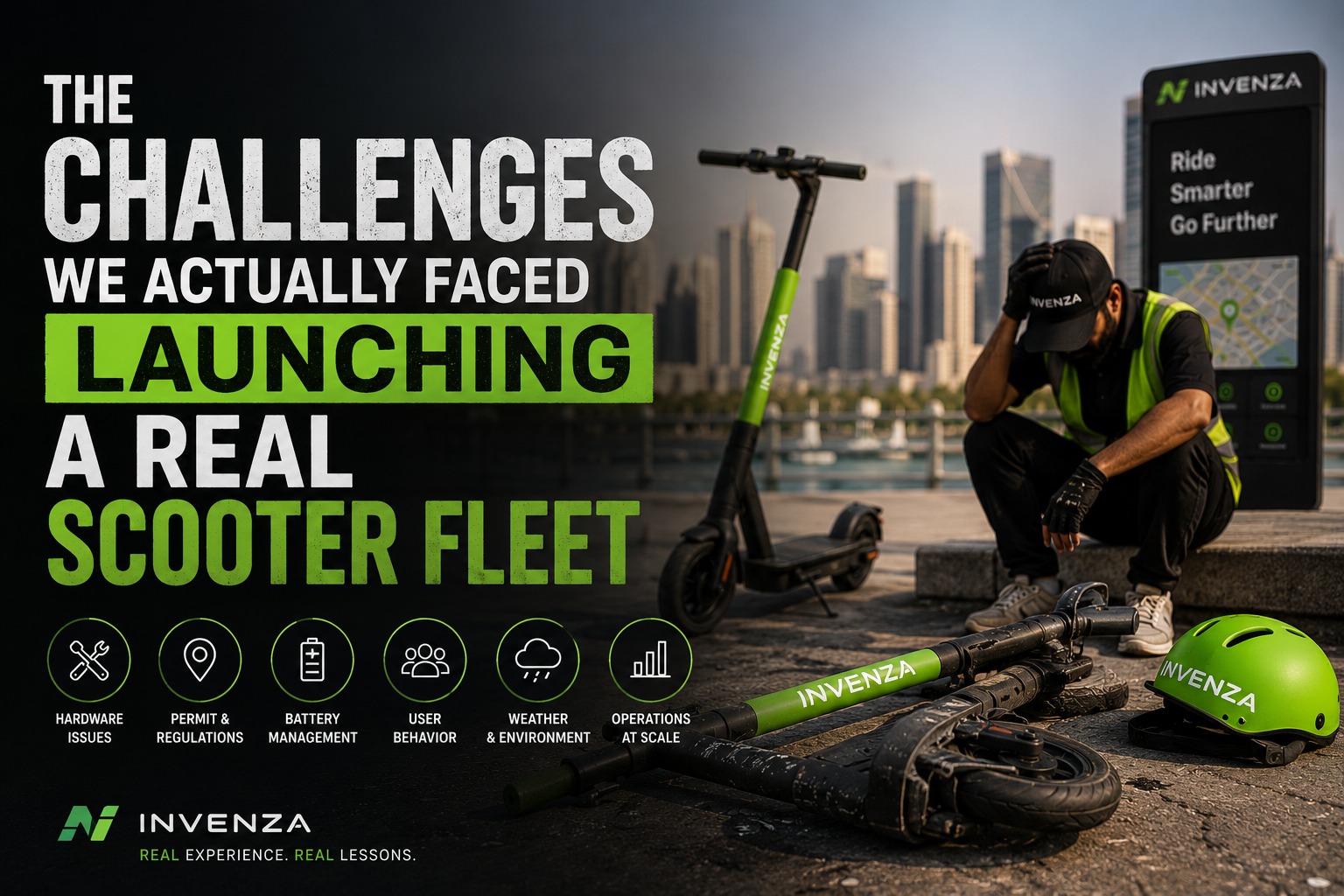
Challenge 1: The Hardware Arrived Different From the Spec
We ordered a specific IoT lock model. What arrived was a hardware revision the manufacturer had updated without notifying us. The firmware was incompatible with our platform’s unlock protocol. We had 80 scooters on the ground and zero of them were operable. It took 11 days and three firmware builds to resolve. Eleven days of paying for vehicles that generated zero revenue.
Lesson: Always request a pre-shipment sample unit for integration testing. Never take a manufacturer’s word that “it works the same” after a revision.
Challenge 2: The First Zone Was Wrong
We launched in a zone we believed would perform well based on foot traffic data. It didn’t. The foot traffic was mostly car drivers passing through, not pedestrians who needed last-mile transport. Week two, we moved the entire fleet. Week three, rides tripled. The right zone was 800 metres away from our first choice.
“Mobility demand is hyperlocal. 500 metres can be the difference between a successful deployment and an empty zone.”
Challenge 3: The Heat Problem Was Real
Qatar summers are brutal. Battery capacity drops significantly above 40°C. We saw effective range fall by nearly 35% in peak summer months, which meant more frequent swaps, more field team movements, and higher operational costs. None of our original unit economics accounted for this. We had to rebuild our cost model entirely for the summer quarter.
Challenge 4: Rider Onboarding Was Harder Than Expected
Qatar has a diverse population — over 85% expatriate, speaking dozens of languages. Our app launched in English and Arabic. But we had riders from South Asia, Southeast Asia, and East Africa who struggled with both. The drop-off rate between app download and first ride was significantly higher than industry benchmarks. We resolved it by redesigning the onboarding flow to be icon-first with minimal text dependency.
Challenge 5: The Regulatory Grey Area
Scooter regulations in Qatar were not fully defined when we launched. There were no specific laws about where scooters could operate, what safety equipment was required, or how disputes would be handled. This was simultaneously an opportunity and a risk. We chose to engage proactively with authorities to help shape the framework — which ultimately benefited us when rules were eventually formalised.
11 Days of IoT downtime on launch
35% Battery range drop in summer
3× Rides after zone correction
Challenge 6: Cash Flow in the Early Months
Hardware costs, operational salaries, maintenance, platform fees — the outgoings are front-loaded while revenue builds slowly. Month one, we were operating at about 30% of the ride volume we needed to break even on operational costs. Month three, we were at 70%. Month six, we crossed into positive unit economics. Runway planning is critical. Operators who underestimate early cash requirements are the ones who don’t make it to month six.
What We’d Do Differently
- Start with a smaller fleet (30–40 vehicles) in a single proven zone before expanding
- Test IoT hardware integration at least 60 days before launch
- Build summer battery performance degradation into unit economics from day one
- Hire a local operations manager before launch, not after
- Engage regulators in month one of planning, not week before launch
The honest truth
Every challenge we faced was survivable. None of them were existential. The ones that hurt most were the ones we could have seen coming with more preparation. That’s why we built Invenza — to give operators the tools and knowledge to see them coming.