

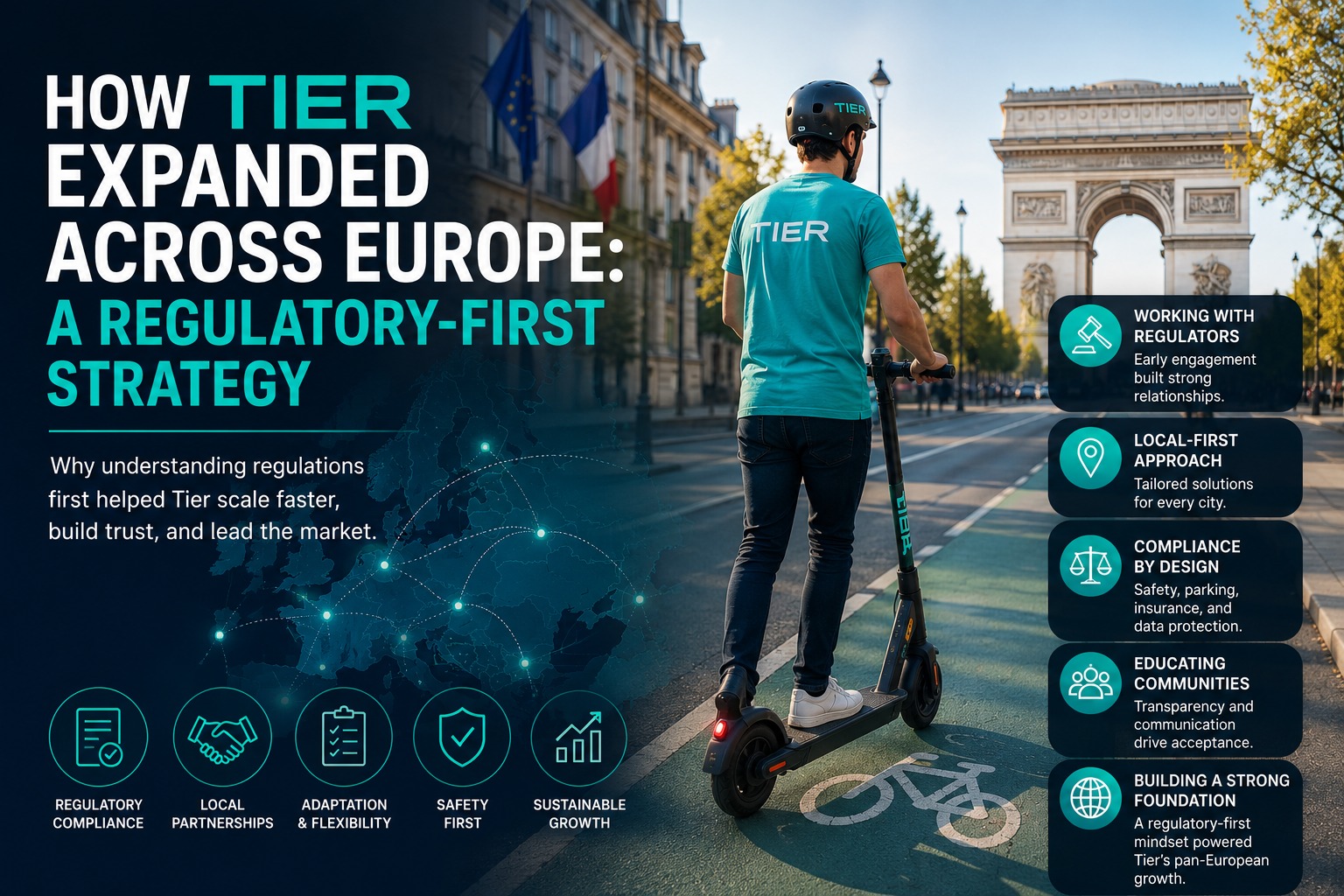
Tier’s city-by-city regulatory approach, swappable battery model, and how working with governments — not against them — became their biggest competitive advantage.
When Bird and Lime were dropping thousands of scooters on European streets and asking for forgiveness later, Tier Mobility was quietly doing the opposite. They were attending city council meetings, co-designing deployment plans with municipal governments, and positioning themselves as a partner in urban transport rather than a disruptor of it.
The result? While competitors faced bans and fines, Tier built a presence in 150+ cities across Europe, the Middle East, and beyond.
Who Is Tier Mobility?
Founded in Berlin in 2018, Tier Mobility is one of Europe’s largest micromobility operators. They operate e-scooters, e-bikes, and e-mopeds across cities in Germany, France, the UK, Norway, the UAE, and more. By 2023, they had completed over 100 million rides and raised more than $600 million in funding.
150+ Cities worldwide
$600M+ Total funding raised
100M+ Rides completed
The Regulatory-First Playbook
Tier’s core strategy was built around one principle: get permission before you deploy, not after. This meant:
- Engaging city transport departments months before launch
- Presenting data-backed proposals for fleet size, zones, and parking
- Agreeing to caps, geofencing rules, and performance reporting upfront
- Accepting smaller initial deployments in exchange for long-term operating licences
“We don’t want to be the company that shows up uninvited. We want to be the company the city calls when they’re ready to launch micromobility.”
— Lawrence Leuschner, Tier CEO
The Swappable Battery Innovation
One of Tier’s most operationally significant decisions was adopting swappable batteries early. Instead of riding vehicles to a charging point (which takes vehicles out of service for hours), Tier’s field teams carry pre-charged battery packs and swap them in minutes on the street. This dramatically improved fleet uptime — Tier consistently reported 90%+ operational vehicle rates, well above industry average.
This also reduced their carbon footprint, which mattered to city partners increasingly focused on sustainability credentials.
How They Handled City Bans
Not every city engagement went smoothly. Paris — one of the largest micromobility markets in the world — eventually voted to ban shared scooters entirely in 2023 following a public referendum. Tier lost that market. But their response was instructive: they pivoted quickly to e-bikes and cargo bikes in Paris rather than exiting entirely, maintaining the city relationship for future opportunities.
Lessons for GCC and Emerging Market Operators
- Don’t launch without government alignment. A single regulatory crackdown can wipe out months of growth overnight.
- Treat city data reporting as a feature, not a burden. Operators who share data proactively build trust with authorities.
- Accept constraints initially. A smaller permitted deployment beats a larger illegal one every time.
- Invest in parking enforcement. Poorly parked scooters are the single biggest trigger for regulatory backlash.
The takeaway for new operators
Tier’s growth was slower than Bird’s in its early years. It was also far more durable. The cities that banned Bird often expanded Tier’s permits. Regulatory patience pays compound returns.